Monday, October 29, 2012

Vocabulary

Chapter eight makes many good points, but also uses many big words. So I took the liberty of defining them for myself here down below:

Quintilian: Named after a Roman rhetorician, believed that history and philosophy can increase an orator’s command of copia and style.
Disinterest: Not being influenced by personal involvement, impartiality. 
Uninterest: Having no interest, curiosity, attention, or excitement towards a subject.
Frankness: The quality of being honest and straightforward in attitude and speech.

Dubious: Hesitating or doubting
Lucidly: In a clear manner. Syntactical: Relating to or conforming to the rules of syntax.
*I got my definitions from the little info place on google where the definition pops up when you search define: a word.

In Response

I read Andressa Quadros' blog Rules Get in the Way and I don't exactly agree with all of her points. It was in response to chapter seven in the book and made the point that it is not always possible to be practically wise because rules and other things beyond our control get in the way. Heinrichs states that practical wisdom "is when the audience thinks you know how to solve the problem at hand" and that it "entails the sort of common sense that can get things done" (67). I think Andressa had this a little confused in her response. She claimed that it was impossible to be practically wise in her experience at Columbia this summer: "How on earth are we supposed to 'make the right decision on every occasion' (68) when rules and regulations cloud our sense of judgment by turning reason into a yes or no answer?"

This is not the way that I interpreted Heinrichs' meaning of practical wisdom. According to the way I understood practical wisdom, it is being able to make the right decision in the context of the situation. For example, although it was impossible for Andressa to get back to Columbia from Six Flags because the locker system broke down there are ways she could have avoided receiving such a harsh punishment from the summer program. Upon finding out that the locker system was not working and that they would be unable to make the curfew, it would have been wise considering the situation for someone to use a payphone to call a member of the Columbia staff to let them know about the dilemma. If there was no money to be found, the group could have gone to an information or help point and tell a member of Six Flags staff what had happened to see if they could lend a phone. If they didn't know the number to call, they could have looked up the number for Columbia university in the phone book and been directed to the office of summer programs from the main line.

So it's clear that rules do not have to get in the way. Practical wisdom is finding a way to make the right decision even when it appears impossible.

Wednesday, October 24, 2012

Bragging Virtuously

I'm trying really hard not to start off every blog by talking about how much I like this book, but so far it's not working out very well. I really like this book. It's just so useful! I thought reading nonfiction like this would be unbearably boring but I'm enjoying it so much.

In chapter six the author talks more about how to be persuasive with a few specific techniques. He talked about virtue, bragging, flaws, and switching sides. Virtue in a rhetorical context is extremely different from virtue in any other context, and it was interesting to see him explain the changes in its definition. I was able to grasp the concepts that he demonstrated through his examples because they were interesting and relatable.

Also, the way he ties this virtue in with ethos is very effective. Ethos is showing your audience that you share their values so they will see you has virtuous. However, I found a video on youtube that explains logos, ethos, and pathos but the definition of ethos was very different than this one. In the video he states that ethos is making yourself be perceived as an authority and for this reason you will be believed. Yet Heinrichs does not present ethos in this way. Heinrichs present ethos as making yourself familiar to the audience - not in tone but rather in beliefs. If the audience thinks that you have the same objectives as it does then you will be much more convincing. In my opinion, the video is correct in that ethos is about credibility, but I disagree with the point about authority. Intelligent people will not tend to blindly believe authority figures. People must be given a reason to believe someone other than their higher status. Ethos is showing the audience that you are trustworthy and credible because you share their values and you are on their side.

Monday, October 22, 2012

Debate Night

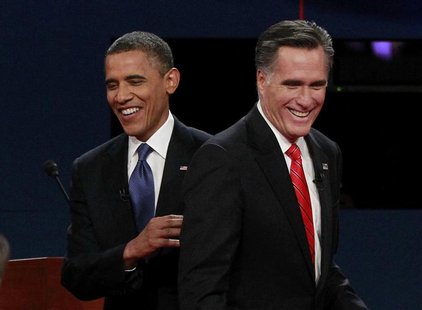
This debate, from the start, is much more interesting than the last presidential debate. Tonight, Obama and Romney are much more direct - interrupting and trying to talk over each other. I like the topic of international policies and relations much better than the others, probably because it's slightly more relevant to me but also because I know much more about it than things like tax policies. 

As they discuss the international policies, currently with Syria, both candidates speak with a lot of pathos. Especially when they were talking about the deal with Iraq and Osama Bin Laden, the way Romney said that they can't "kill their way out of it" was an extremely impactful statement. Obama also uses pathos when he talks about the "American blood on Gaddafi's hands" because that hits home with so many Americans. Also when Obama speaks about visiting sites where missiles had been fires he says he imagined himself in the place of the families of those who had been attacked, "as if those children had been [his] children."

There is also a lot of logos being used as Romney talks about what should be being done with Libya, Syria, and Egypt. Obama is also using logos in his rebuttal showing that Romney's ideas are not that different than what is already being done because what they are doing is exactly the right thing to do. Really there is heavy logos on both sides. I mean obviously, it's a debate. They have to be logical in defending their policies and ideas so people will understand them. 

Ethos comes strongly into play as well because the candidates are aware that people don't just vote for a presidential candidate, they vote for a person. Obama is sure to bring up Romney's lack of continuity in his opinions on different issues and Romney mentions Obama's inability to fulfill his promises from last election. They attack each other a lot, not even just their policies but things that they have said and then they say that what the other one said is a lie. They adress each other frequently and directly. It feels very aggressive.  


The candidates use deliberative rhetoric when comparing policies and plans for relations, such as Obama's "let the American people decide who is going to be more effective." The forensic rhetoric they use is in how they refer back to previous statements and plans if they have been effective or not or contradicted current plans. This requires accuracy and checking each other's facts from the past. The last, demonstrative rhetoric, is the most evident. Both candidates speak about their moral values and how they relate to their policies. Everything is very emotional and inspirational and pulls in their personal beliefs. 


Overall, it was a very entertaining debate. I enjoyed watching this one, even though the candidates mainly agreed on most things. It is an interesting and relevant way to examine rhetoric in the real world. 


Thursday, October 18, 2012

Getting People to Agree With You

I think I am really going to like this book. The first thing that made me like it was the way the author writes: informally and understandably. I like the way he comes across on the page, he seems like a nice guy, and therefore I believe him when he tells me how to make people agree with me. There's some how-to-the-what in there - if he had written in a less personable style then I would have been less likely to enjoy reading and therefore less inclined to to like the author as a person and believe what he told me. Pretty nifty little trick he's got there.

I also really like it because it's useful. The things he's talking about are things that happen or can be used everyday. I'm already thinking about how I'm going to apply these concepts in my college essays: what do I want my reader to do in the end? Accept me, like me, think I'm a cool person that they want at their university. How do I do that? Make them feel the same things I feel towards my subject, make them think that it's the correct way to feel, and then make them think that I'm so correct they just have no choice other than to accept me into their university. If only it were so easy. But I do understand all the points that Heinrichs is making and can clearly see how effective the methods he talks about are in real life.

He's right when he talks about the importance of rhetoric in the introduction, it is an extremely useful tool. The proper use of rhetoric is a skill that everyone should know - especially those who dream of being very successful in the future. Getting people to agree with you is a skill that has many obvious benefits if you're good at it. I want to be good at it. I'm looking forward to finishing this book and seeing if I can get my way more often. If I could also get into college that would be cool as well.

Thursday, October 4, 2012

It Wasn't Malaria

As Zell and Hughes reach the end of their trip to Haiti and they find themselves low on money, Zell wakes up one morning extremely ill. The way Hughes describes the situation shows his true care for Zell as well as Zell's personality. The main rhetorical mode used here I would say is pathos as Hughes gets a little sentimental with his friend in such a weak state.

The morning that Zell wakes up extremely weak, Hughes is "frightened" as he asks if a doctor is necessary (35).  The fact that he was not just nervous or mildly concerned shows the true connection these two men have made over their time travelling together and have really become excellent friends. Also, Hughes was willing to pay for the doctor, medicine, and extra night at the hotel in order to stay with his friend, despite the fact that "all of this unexpected expense meant that [they] would have scarcely twenty dollars left to get all the way from Havana to New York" (35). However, Hughes does not get worried or frustrated about the money but instead goes on to praise Zell, "a big husky young Negro," and reminisces over their times with the girls in Cap Haitien. Hughes describes Zell as "a solid, amiable, easygoing fellow" that sometimes got over excited in anger (36). This use of fond diction shows Hughes' care for Zell and how much their friendship means to him.

Wandering Stylishly

I enjoy Langston Hughes' writing style because it's very sincere and descriptive. The diction he uses is not simple, but it is not assuming or overly complex. Hughes wants to be understood by his reader. This makes his writing very clear and his ideas comprehendible.

When he and Zell arrive in Cap Haitien I think the main rhetorical mode that Hughes employs is ethos. When they are staying in the capital, Hughes tells the reader that, while Zell tried to learn Spanish, he "devoted [him]self to the local patois" (20). The use of the word devoted shows the reader that Hughes did not just have a vague interest in the language nor did he try for a few days and then give up. The fact that Hughes devoted himself to patois tells us that he did not give up until he learned it. Just the choice of that one word gives the reader information on Hughes' personality and cultural sensitivity. 

This trait of Hughes' shows up many times as he describes his time in Cap Haitien, and it is one of the reasons I like him so much. As he describes the Haitian conga dance he creates a picture of men and women "solemnly enticing each other as though in a trace... Too self-centered to be vulgar" (22). This description caught my attention because many other American travelers may have just left that description at "a sex dance undisguised," yet Hughes was careful to be accurate and sensitive in his description of this scene (22). He chose his diction carefully to portray this image of Haitian culture exactly as he saw it. 

Hughes' sincerity and sensitivity shows through his precise and clear diction. He is careful about what he says and how he says it and this makes reading his work enjoyable.

Tuesday, October 2, 2012

Enough of this Ridiculousness

Greene is a self-proclaimed "descriptivist" - someone who describes language as it is used, while Garner is apparently a "prescriptivist" - someone who focuses on how language should be used. Greene claims that Garner would call him a "permissivist" - someone who is very lenient toward or indulgent of a wide variety of social behavior.

The debate is interesting to read, yet at times a bit difficult to follow. I don't know the difference between restrictive and non-restrictive clauses and had no idea that you weren't supposed to use "which" for one of them or "that" for the other. The intricate grammar details in the debate were completely lost on me. However, I did manage follow the two different sides and then come to the conclusion that they really aren't very different at all. Both Greene and Garner are moderates of their respective labels, so really only slight technicalities differentiate the two. Basically, very basically, Greene believes that the language that is used is correct and will overpower any set rules while Garner believes that even native speakers can commit errors in language and that we must have rules to guide these. Its a close one, but I'm going to have to side with Garner.

I think its ridiculous that the "that" vs "which" debate is a very legitimate thing and many important writers have thoughts on it, because honestly no one cares. Details as small as that one are not noticed by the general public, and even then usually forgotten by the people who made them up in the first place. And most of those really old rules from when they were writing the bible definitely should not continue to apply - times have changed. However, other than the old and ridiculous ones, rules in language should exist. They may be regional, I'm not saying that people speaking English in India have to abide by exactly the same rules as people speaking English in Canada, but in general guidelines must exist. Its like the Pirate Code from Pirates of the Caribbean, "they're more like guidelines anyway." People can't just talk any old way they please and claim to be correct because they are native speakers. I'm a native speaker and I often make mistakes in grammar as well as say "yall" on a daily basis. Yet I know when I commit errors in grammar (or sentence structure or whatever it may be) because of the guidelines set in my head regarding my language. It doesn't mean to say that people without these guidelines are illiterate or dumb, just that they haven't had the proper education, but without the basic grammar rules they are still incorrect.

If people just spoke any old way they wanted to, no one would understand each other. If we spelled any old way we wanted to, it would be impossible to understand the difference between "know" and "no" or "there", "their", and "they're". The point of language is that it is common, that it allows communication. If you let people in different areas just do whatever they want with it, eventually no communication will be able to occur. Loose rules should be in place, yet reasonably so with cultural and global aspects taken into consideration. Basically, the way things work right now.